Proposal
Document QA with AWS Bedrock
Intelligent Document Analysis System using RAG
1. Executive Summary
The Document QA system is a serverless application designed to revolutionize how users interact with documents. By leveraging AWS Bedrock for Generative AI and RAG (Retrieval Augmented Generation) technology, the platform allows users to upload PDF/TXT documents and ask natural language questions. The system provides accurate, context-aware answers by retrieving relevant information from the uploaded documents, significantly reducing manual search time and improving information accessibility.
2. Problem Statement
What’s the Problem?
Traditional document search methods (keyword matching) often fail to capture context or semantic meaning. Manual document review is time-consuming, error-prone, and inefficient, especially for large volumes of text. Users struggle to extract specific insights quickly, leading to productivity bottlenecks.
The Solution
We propose a Serverless RAG-based Chatbot using AWS Bedrock (Amazon Titan). The solution involves:
- Upload & Processing: Users upload documents to S3; Lambda functions trigger text extraction and embedding generation.
- Vector Search: Embeddings are stored and queried to find relevant document chunks.
- Generative AI: AWS Bedrock generates natural language responses based on the retrieved context.
- Serverless Architecture: Built on AWS Lambda, API Gateway, and DynamoDB for automatic scaling and cost efficiency.
Benefits and Return on Investment
- Efficiency: Reduces document analysis time from hours to seconds.
- Accuracy: RAG ensures answers are grounded in the provided document, minimizing hallucinations.
- Cost-Effective: Serverless pay-as-you-go model (estimated < $5/month for low usage).
- Scalability: Automatically handles varying loads without manual infrastructure management.
3. Solution Architecture
The platform employs a modern serverless architecture to ensure scalability, security, and performance.
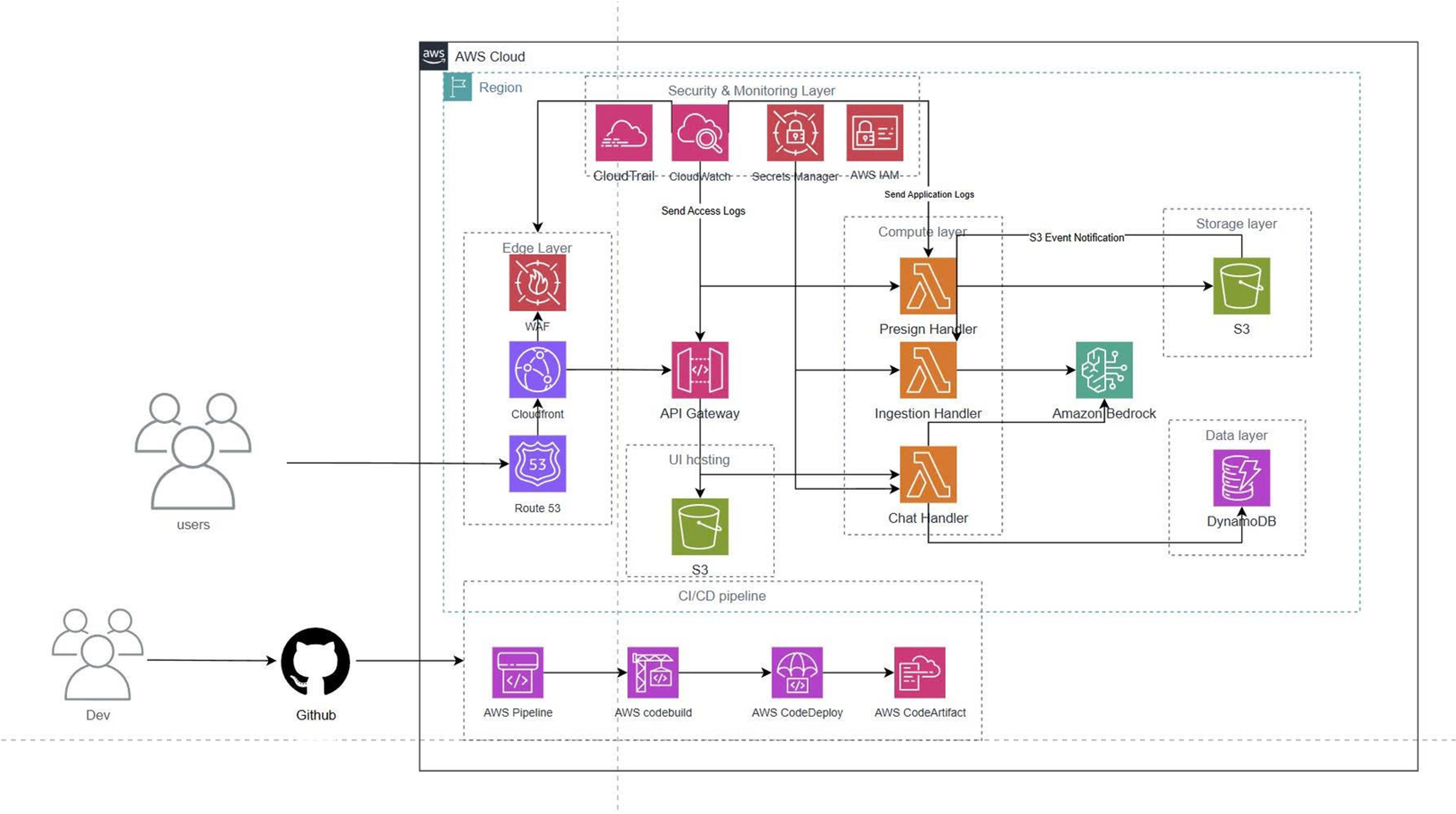
AWS Services Used
- AWS Bedrock: Provides the Foundation Models (Amazon Titan) for embeddings and text generation.
- AWS Lambda: Serverless compute for handling API requests, document processing, and orchestration.
- Amazon API Gateway: Manages REST API endpoints for the frontend.
- Amazon S3: Stores raw uploaded documents and frontend static assets.
- Amazon DynamoDB: Manages user sessions and chat history.
- Vector Store: (Implemented via Lambda/Local or dedicated vector DB) Stores document embeddings for semantic search.
Component Design
- Frontend: Hosted on S3 (or Amplify), providing a user-friendly chat interface.
- API Layer: API Gateway routes requests (
/upload,/ask) to Lambda functions. - Processing Layer: Lambda handles text extraction, calls Bedrock for embeddings, and performs vector similarity search.
- AI Layer: AWS Bedrock generates responses using the retrieved context and user query.
4. Technical Implementation
Implementation Phases
- Phase 1: Foundation (Weeks 1-4): Setup AWS environment, Bedrock access, and basic backend logic.
- Phase 2: API & Security (Weeks 5-7): Develop API Gateway, Lambda functions, and implement CORS/Security.
- Phase 3: Frontend Development (Weeks 8-11): Build the React/Next.js interface and integrate with APIs.
- Phase 4: Testing & Deployment (Weeks 12-14): End-to-end testing, optimization, and final deployment.
Technical Requirements
- AI Model: Amazon Titan (via Bedrock) for Embeddings and Text Generation.
- Backend: Node.js/Python on AWS Lambda.
- Infrastructure as Code: Serverless Framework or AWS CDK.
- Frontend: React.js / Next.js.
5. Timeline & Milestones
- Month 1: Architecture Design, AWS Setup, Backend Core (Upload/Embeddings).
- Month 2: RAG Implementation, Vector Search Logic, API Development.
- Month 3: Frontend Integration, UI/UX Polish, Testing, and Launch.
6. Budget Estimation
Estimated Monthly Costs (Low-Medium Usage)
- AWS Bedrock (Titan): ~$0 (Free Tier / Low cost per 1k tokens)
- AWS Lambda: ~$0.20 per 1M requests
- Amazon S3: ~$0.023 per GB
- Amazon DynamoDB: ~$0.25 per 1M requests
- Amazon API Gateway: ~$3.50 per 1M requests
Total Estimated: < $5.00 / month
7. Risk Assessment
Risk Matrix
- Hallucinations (AI Errors): Medium Impact, Medium Probability.
- Cost Overruns: Medium Impact, Low Probability (Serverless).
- Data Leakage: High Impact, Low Probability.
Mitigation Strategies
- Hallucinations: Strict RAG implementation (grounding answers in context).
- Cost: Set AWS Budget Alerts and usage quotas.
- Security: Use Presigned URLs for S3, IAM roles with least privilege.
8. Expected Outcomes
Technical Improvements
- Fully automated document analysis pipeline.
- Sub-second retrieval latency for vector search.
- Scalable architecture supporting concurrent users.
Long-term Value
- A reusable RAG framework for future knowledge base applications.
- Significant productivity gains for users needing quick information retrieval.
9. Team Structure and Responsibilities
| Name | Student ID | Primary Role | Email/Contact Info |
|---|---|---|---|
| Nguyễn Lê Anh Quân | SE192307 | Team Leader/ Cloud Architect | nguyenleanhquan2005@gmail.com |
| Đào Quang Vinh | SE180012 | Backend Developer (Bedrock, RAG) | its.vnhdq@gmail.com |
| Nguyễn Thanh Liêm | SE184163 | Backend Developer | liemntse184163@fpt.edu.vn |
| Trần Đình Phong | SE184217 | Frontend Developer/ UI/UX Designer | phongtdse184217@fpt.edu.vn |
| Dương Nguyễn Gia Huy | SE182202 | QA Engineer/Backend Developer (Bedrock, RAG) | huydngse182202@fpt.edu.vn |
Detailed Responsibilities by Team Member
Nguyễn Lê Anh Quân - Cloud Architect/ Team Leader
Primary Responsibilities:
- AWS architecture design and service selection
- Infrastructure planning and optimization
- Security architecture and IAM policies
- Technical consultation and best practices
Đào Quang Vinh - Backend Developer
Primary Responsibilities:
- Overall project management and timeline coordination
- Team coordination and task assignment
- Progress reporting to instructor/advisor
- Risk management and mitigation strategies
- Documentation oversight and quality assurance
- Build vector search and retrieval logic
- Develop chat/query handler Lambda function
Dương Nguyễn Gia Huy - QA Engineer/Backend Developer
Primary Responsibilities:
- Core backend logic development
- Amazon Bedrock integration (Foundation Models)
- RAG (Retrieval-Augmented Generation) pipeline implementation
- Develop Lambda function for document ingestion
- Integrate Amazon Bedrock Knowledge Bases
- Implement text chunking and embedding generation
Nguyễn Thanh Liêm - Backend Developer
Primary Responsibilities:
- Backend infrastructure and data management
- CI/CD pipeline development
- System monitoring and logging
- Performance optimization
- DynamoDB schema design and implementation
- Conversation history storage logic
Trần Đình Phong - Frontend Developer
Primary Responsibilities:
- User interface design and development
- Frontend-backend integration
- User experience optimization
- Responsive design implementation
- Implement file upload interface with drag-and-drop
- Connect frontend to API Gateway endpoints
- Handle API responses and error states
- Deploy frontend to S3 + CloudFront